Memento
Jérôme Combier
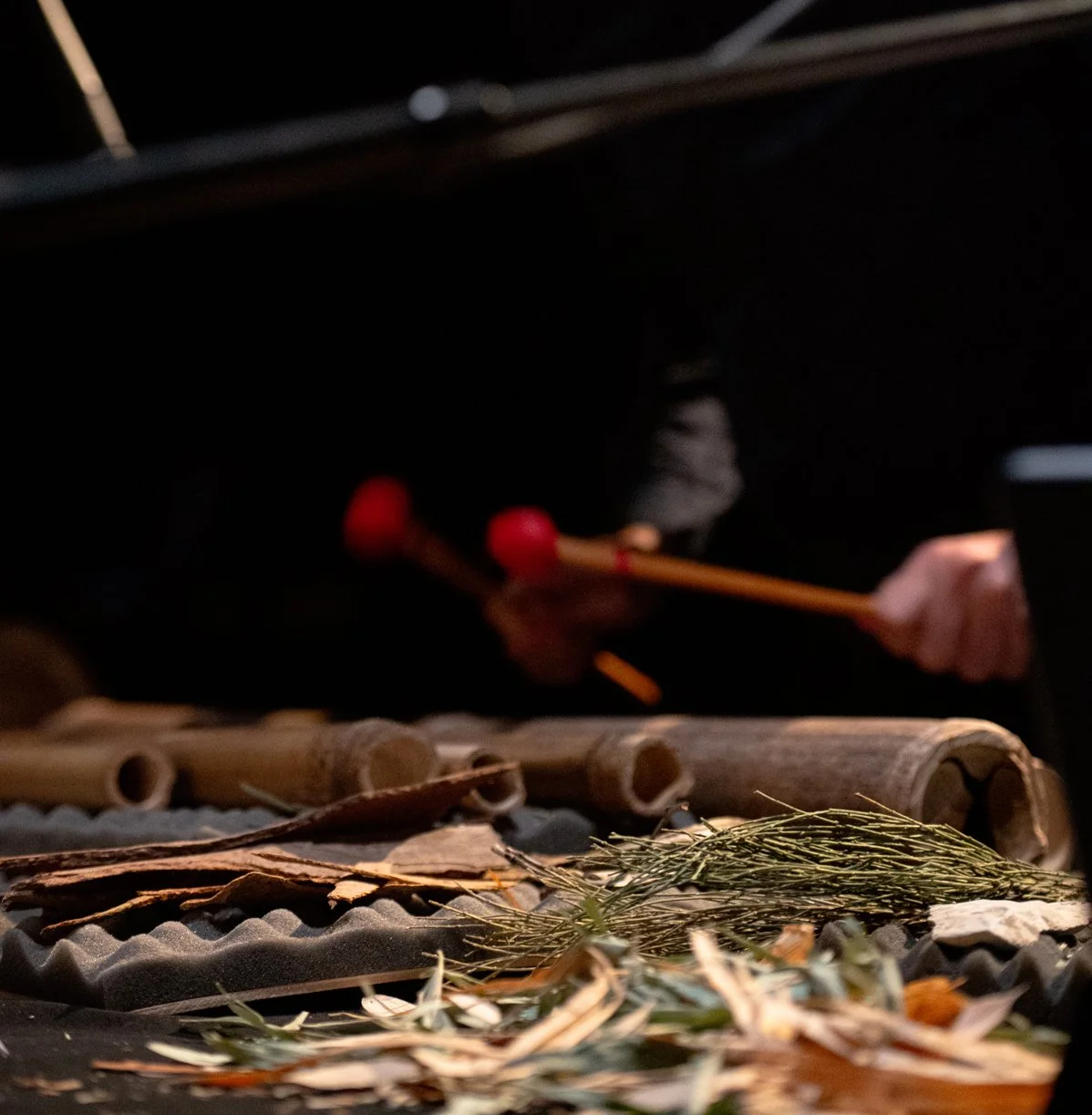
Memento est un cycle musical imaginé par Jérôme Combier qui convoque des matières naturelles (feuilles, pierres, bois, sable, eau, herbe) des matériaux simples (métaux, verre, laine, charbon) et s’interroge sur leur pouvoir à devenir musique ou sinon un sonore signifiant. La musique est à la fois instrumentale, performative, immersive, électronique. Elle fait appel à 7 musiciens disposés autour du public, se déplaçant d’un îlot à l’autre. Au centre du dispositif, un percussionniste-performer officie comme un maître de cérémonie : il manipule des fleurs, fait sonner des pierres, tape sur des métaux, des morceaux de bois. De ces matières, et de ces gestes émanent des sons qui au moyen d’une microphonie particulière sont ensuite légèrement transformés, sons moitié concrets, moitié électroniques apparaissent tout d’abord sous la forme d’interludes puis imprègnent peu à peu la musique en soi.
Le cycle fait référence aux univers plastiques de Jannis Kounellis, de Giuseppe Penone, de Claudio Parmiggiani, de Richard Long, à cet art qui tente de mesurer un « écart » : celui qui sépare la nature et le geste artistique, la matière et sa manufacture ou sa transformation, celui qui sépare les phénomènes naturels (le feu, l’érosion) et l’action humaine (sculpter, creuser, casser, disposer), celui qui sépare la nature des lieux où l’art a court. En quelque sorte, ce qui réunit les pratiques de ces artistes (et de beaucoup d’autres) serait la tentative, forcément un peu vaine, de mesurer à l’aune d’un temps géologique le maigre temps de l’homme.
MEMENTO est aussi un geste performatif, au sens où les arts plastiques l’entendent, qui s’incarne dans la partition électronique. Un instrumentiste, percussionniste-performer, debout devant une grande table en bois, ou simplement une surface constituée de planches en bois, anime toutes sortes de matières qui y seront disposées selon une partition écrite : des feuilles mortes, de fleurs séchées, des bambous, des pierres, des branchages, des plaques de métal, de la paille, des métaux bruts…
MEMENTO invite à entrer dans un espace particulier : un système de praticables divise l’espace du concert en plusieurs sous-espaces. Aux quatre coins de la salle, de grandes plaques de métal encadre le public, évoquant lointainement les « lamiere » (feuilles) de Jannis Kounellis. Au centre de cet espace, des matériaux bruts et simples sont disposés sur une table que manipule le percussionniste : des fleurs, du sable, du bois, des pierres et quelques métaux résonnants : barres et plaques de métal. L’espace de la salle de concert devient ainsi l’évocation d’un autre lieu, un espace dénaturé. La disposition du public ne sera plus frontale, mais elle sera disséminée dans l’espace de concert en soi.
Programme
Fumo di pietra / tribute to Claudio Parmiggiani (2019)
pour flûte, clarinette, piano et violoncelle
Musica povera 1, 2 et 3 (2024)
Pour percussions
Le ombre delle cose (2020)
pour accordéon, piano, violon et violoncelle
(commande du festival Henri Dutilleux)
Luce e polvere (2024)
pour flûte, clarinette, trompette
Wood and bones (2020)
pour violoncelle
(commande de Radio-France)
Lamiere (2024)
Pour 4 plaques tonnerre
Slate circle / Tribute to Richard Long (2024)
pour percussion solo, flûte, clarinette, trompette, accordéon, piano, violon et violoncelle + chef
Waterlines / Tribute to Richard Long (2024)
pour flûte, clarinette, trompette, accordéon, piano, violon et violoncelle + chef
Distribution
Conception, musique Jérôme Combier
Lumières Pauline Falourd
Réalisateur informatique musical et son Etienne Démoulin
Ensemble Cairn
Flûte Cédric Jullion
Clarinette Ayumi Mori
Trompette André Feydy
Percussions Corentin Marilier
Accordéon Fanny Vicens
Clavier Caroline Cren
Violon Constance Ronzatti
Violoncelle Alexa Ciciretti
Direction Guillaume Bourgogne
Éditions musicales Henry Lemoine
Photographies © Pierre Gondard

Dates
30 Septembre 2023 – Festival Musica,
Strasbourg, Palais des fêtes
9 Mai 2024 – Festival Propagation,
GMEM, La Friche Belle de Mai, Marseille
5 Juillet 2024 - Festival Les traversées,
Abbaye de Noirlac
7 Octobre 2024 – BCV concert Hall,
Lausanne